At the 105th ARTCaffè, Fred Farrow explored how his artistic practice investigates the construction of meaning, identity, and contemporary mythologies.
Moving across painting,sculpture, and spatial installations, he described how his works operate through layering, repetition, and carefully structured absences that invite viewers to complete what is not shown. He discussed his interest in mediated realities—artificial landscapes, digital identities, and synthetic imagery—as spaces where narrative and consciousness are negotiated today.
Fred also reflected on collaborative practices and the development of projects such as ZhouKe, which examines visibility, agency, and technological mediation. Rather than offering fixed interpretations, his work proposes open systems where meaning emerges gradually through encounter.
Below is a recap of The Talk.
***
Fred Farrow: It’s an honor to be back at ARTCaffè—this time as the speaker. I’m very proud to have been invited and to participate in this wonderful tradition that began in Shanghai and now continues in Seoul and elsewhere around the world. It’s a great opportunity to share and discuss art in an informal setting, which I really enjoy.
Today I’m presenting a new work that will officially open next week in Saigon, Vietnam. Because of a twist of scheduling, you’re actually seeing it before the opening—so this is something like a live preview or even a small premiere.
I’d like to start with a piece from earlier in my practice.
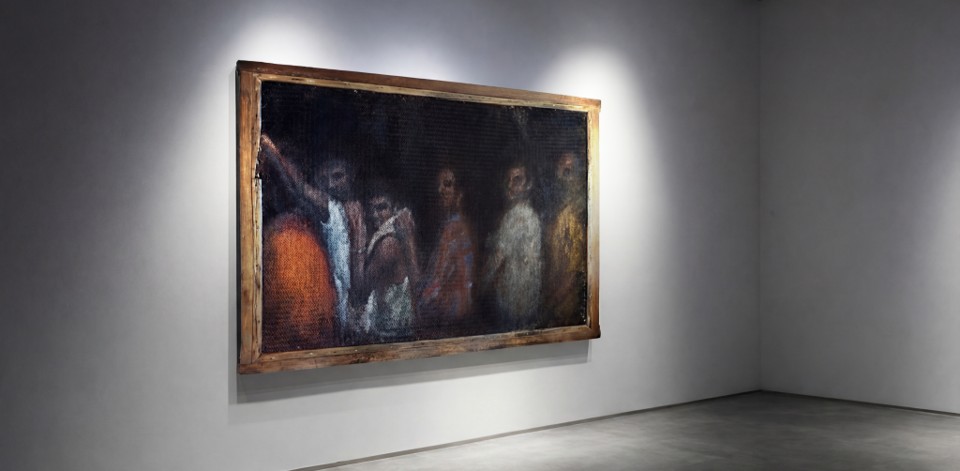
Raffaella visited my studio in Shanghai years ago, and this work was there at the time. The studio was quite chaotic—almost like an explosion of ideas—with artworks covering every surface. This piece is a self-portrait painted on a traditional Shanghai woven bed. The woven rope structure creates a surface similar to a canvas, but with large gaps between the threads. Often there simply wasn’t enough material to paint small details—sometimes there was nowhere to place the brush.
That absence became an important part of the work. The viewer has to fill in the missing information. The gap becomes structural. This fascination with absence has continued throughout my practice.
I’m also very inspired by religious sites—not so much because of belief, but because of how they tell stories visually and non-verbally. Objects like incense burners, folded paper offerings, stones, or crosses form meaning collectively. No single object carries the full message, but together they create a narrative.
This type of constellation of meaning is something I’m very interested in.
The title of this talk refers to myth-making. I borrow the concept of myth from the writer Yuval Noah Harari, who famously argues that things like money, human rights, and even nations are shared myths—stories that people collectively believe in.
What fascinates me is how such myths are created visually.
I’m also deeply inspired by magic realism—writers such as Gabriel García Márquez or Salman Rushdie. When I first read their work, I thought: it would be wonderful if I could create visual art in a similar way.
My practice often tries to create constellations of works that together form a narrative space. A single object is rarely the artwork on its own; meaning emerges through the relationships between multiple elements.
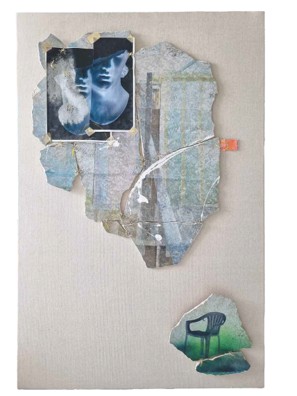
The new project I’m presenting today is titled ZhouKe.
ZhouKe is a metaphysical sculpture that exists across objects, images, and networks. It is not a single object but rather a distributed artwork—a unit of cultural information.
In other words, the sculpture exists through its different manifestations.
At the center of the project is a character loosely based—physically and spiritually—on my wife. We met while I was living in Shanghai. Through many conversations about everyday life in China, feminism, politics, and internet culture, this character gradually developed.
Identity in this project, which has taken about nine years to develop, becomes something fluid—almost like clay that can be shaped.
Interestingly, the project also involved real negotiations between me and the character. Questions of authorship emerged: how much of the character belongs to me, and how much to it? These discussions became part of the process.
At the show soon to open, visitors enter the exhibition through a building in Saigon where a generative artwork is projected at the entrance.
Black gestural lines repeatedly attempt to fill the screen, but they always fail. The program constantly generates new forms, endlessly trying again. Nearby there is a bucket of ink, so the smell of ink fills the entrance space.
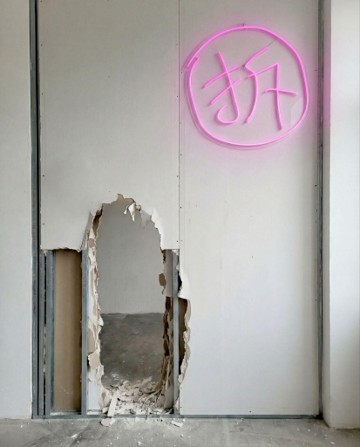
The doorway itself is boarded up with a rough opening carved through it. Above it is a neonsign reading Chāi, meaning “to demolish.” In Chinese cities, this character marks buildings scheduled for demolition as part of redevelopment.
Entering the exhibition is therefore like stepping into a space marked for destruction—an unstable space where structures, identities, and systems are about to be rewritten.
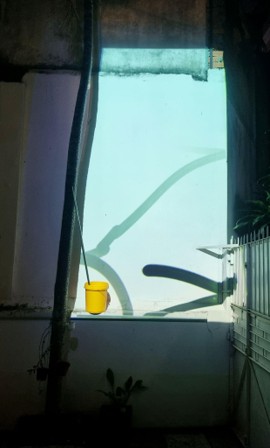
Inside the main gallery space, the character ZhouKe appears as a hologram behind a razor-wire fence structure.
The animation resembles an idle character in a video game—the moment before a player selects which character to control.
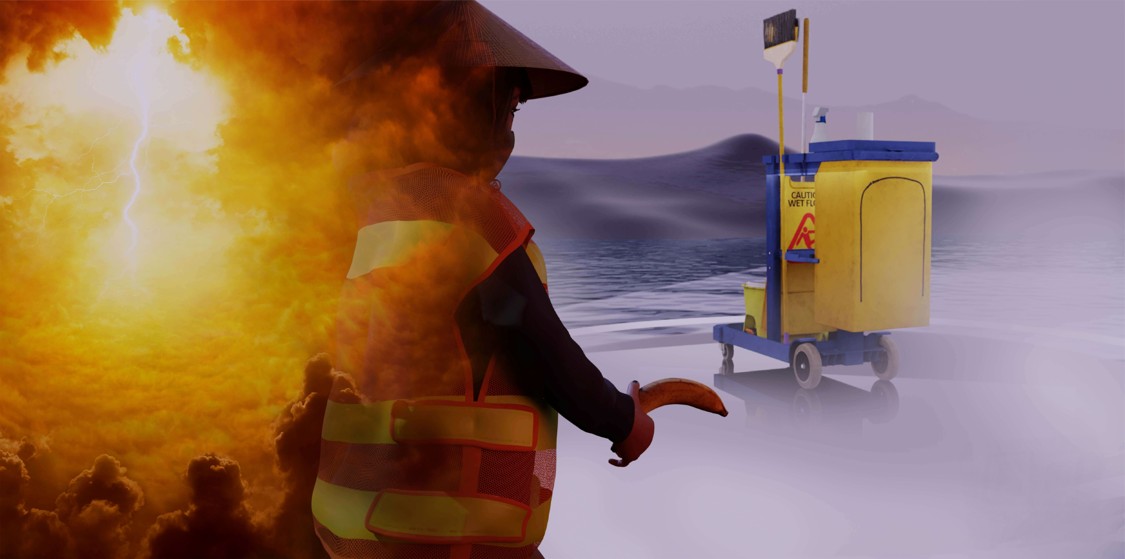
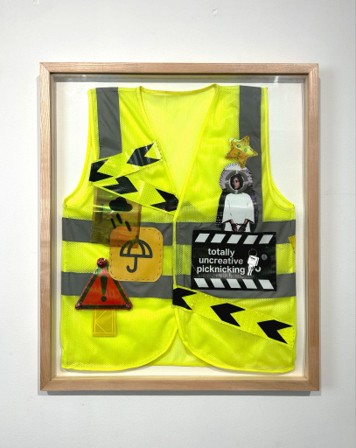
The figure wears the uniform of a street cleaner, something commonly seen across Chinese cities but often socially invisible. The uniform becomes both a symbol of anonymity and a visual thread connecting different parts of the exhibition. It represents a kind of quiet witness inside large social systems.
Several works explore systems of authority and control.
A three-channel video titled Patriarchy shows ZhouKe arm-wrestling a construction excavator. The excavator towers above her—both machine and monster. The work reflects on structures of power that appear immovable yet are constantly being negotiated.
Elsewhere in the exhibition, safety vests are embroidered with strange protest slogans. Some of the phrases were generated using an early language model trained on centuries of English insults, producing surreal expressions like “Totally Uncreative Picnicking.” This reflects how language evolves under conditions of censorship, mutating into strange and unexpected forms.
Another work references the social credit system through a set of five-star badges given to visitors.
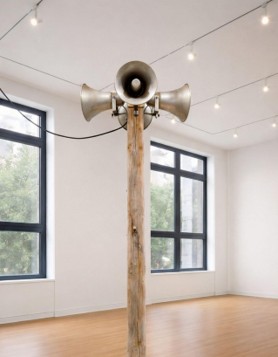
Many elements of the exhibition address networks and digital systems. Mobile-phone-like screens display game environments where the character appears in imagined scenarios. An augmented-reality sculpture of a street-cleaning trolley can be viewed through a smartphone. The work is titled May 35th, referencing creative online strategies used to avoid censorship around the Tiananmen anniversary.
There is also a peephole installation in which visitors see themselves through a surveillance camera. In a later version, viewers wear a VR headset and become the camera itself—turning the observer into part of the surveillance system.
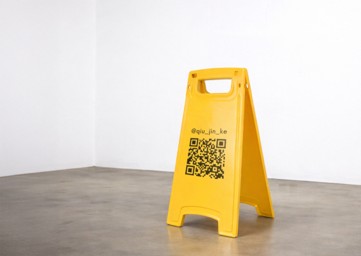
Another part of the project exists online. ZhouKe has an Instagram account that functions as an autonomous bot. It posts poetry and commentary inspired by the revolutionary feminist writer Qiu Jin.
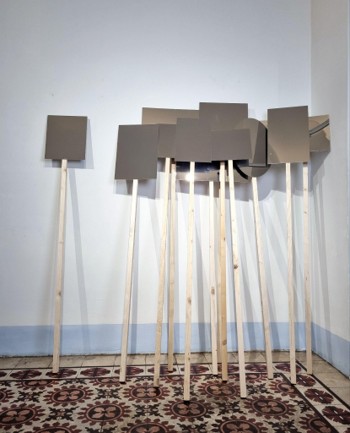
In the gallery, polished stainless-steel protest placards reflect the viewer’s face, placing them inside the protest image. This blurs the line between participation and observation.
Upstairs, a small AI-generated print shows a hand planting a flag on an island. The image is entirely synthetic—there is no real land and no real hand. It references the emerging geopolitical competition in artificial intelligence and the new territories being formed in digital space.
Landscape also appears as a recurring motif throughout the exhibition, reflecting my long-standing interest in Chinese landscape painting. But here landscape is not treated as a depiction of nature. Instead it functions more like an internalized process, a way of thinking about space, time, and how human actions unfold within larger systems, much like the landscape traditions in Chinese painting where the image becomes a structure for thought rather than a view.
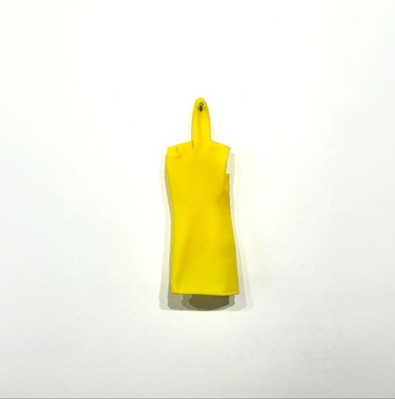
The final piece is titled Shan, meaning “mountain.” It consists of a glove nailed to the wall. Interestingly, this work was conceived by the bot character itself. I simply executed the idea. This raises questions about authorship—about what it means to give creative agency to a system or a character.
For that reason, the entire project has been released under a Creative Commons license. In a sense, it is open source. The artwork is meant to exist beyond me, continuing to mutate and circulate as a cultural signal.
What I hope to have shared with you today is not just a series of objects, but a system—a constellation of images, actions, and ideas.
Together they form what I would call a unit of cultural information.
And that unit, in fact, is the artwork.
"Throughout my work, I've been much inspired by religious sites, by their visual, non-verbal storytelling. Altogether, there's not one particular thing that holds that essence, but rather all of it together — or indeed a framing of absence. The type of stories I'd like to tell are hugely inspired by works of magical realism. Years ago I was reading those books and thought it would be great if I could make art like that. I try to create a constellation of works."
All the pictures from The Talk's presentation are courtesy of the artist.
Thanks to those who joined in person and online, and to the many connecting nodes who actively helped spread the word about this event.
A special mention goes to Belesì, who joined from Italy with an enthusiastic audience.